
A New Information Order?
The Changing Relationship of Filipinos with News Media

There is a version of the Filipino news consumer that public discourse tends to assume: someone scrolling through Facebook, sharing headlines without reading them, absorbing misinformation because they do not know any better. This patronizing view, however, casts the country’s information problem as a literacy deficit. The reality is more complicated, and in some ways, more troubling.
In this WR NUMERO Public Opinion Letters, we examine the demand side of that problem through national survey data, mapping how Filipinos perceive misinformation, how much they trust the media sources they use, and how often they use them.
The picture that emerges from this data is of a public that is neither uninformed nor fully protected. Filipinos know that misinformation is widespread. They identify the platforms where it concentrates. They are skeptical of journalists, deeply wary of influencers, and largely distrustful of the social media platforms they rely on most.
And yet the daily rhythms of their media lives remain largely unchanged, shaped less by their own assessments of reliability than by the gravitational pull of platforms that have become inseparable from social and civic life. The misinformation problem in the Philippines, then, is less about ignorance than it is about entrapment.
The information disorder in the Philippines
The Philippines has long been regarded as one of the world’s most challenging environments for information integrity, recognized as ‘patient zero’ in the fight against disinformation. With nearly 98 million active internet users and almost 84% online penetration, the country offers fertile ground for the rapid spread of both news and falsehood. In 2025, Filipinos ranked second among the heaviest social media users globally, spending an average of four hours and 50 minutes online per day.
This digital saturation has come with compounding costs. The Reuters Institute for the Study of Journalism’s 2025 Digital News Report describes the country’s information environment as shaped by “information disorder, often amplified by political influencers and partisan media,” a disorder now intensified by the political fallout between President Ferdinand Marcos Jr. and Vice President Sara Duterte, whose rival camps have flooded online platforms with competing narratives. Trust in individual media brands slid across the board in 2025, even as overall trust in news held at 38%. This is a figure that, while improved from lows during the Duterte era, still means nearly two in three Filipinos do not trust the news they consume.
The misinformation problem here is structural. Political operators have invested heavily in coordinated influence networks, with one study estimating that between 600 million and 1.5 billion pesos were spent on covert influencer operations during the 2022 national elections alone. The practice has become sophisticated enough to blur the line between political commentary and manufactured consensus. More recently, the emergence of AI-generated content and political deepfakes has added a new layer of complexity, raising the prospect that the already-difficult task of identifying disinformation will become harder still. Furthermore, foreign malign operations have also been documented across several incidents, particularly targeting interference in domestic politics, elections, and national security issues.
Countering falsehoods is especially difficult when platforms discount their role in its spread. In 2025, Meta discontinued its third-party fact-checking program—first in the United States, then eventually globally—prioritizing X-style community notes and rejecting any responsibility for the spread of false information. The move drew sharp criticism from the fact-check journalists, which has long pushed for platforms to be held accountable for the content they amplify.
In the Philippines, legislative responses remain fraught. A pending anti-disinformation bill in Congress has drawn warnings from journalists and press freedom advocates, who caution that its broad language risks becoming a tool for censorship rather than a check on falsehood.
It is against this backdrop that the survey data this article draws on takes on its full weight. The question is not whether Filipinos are living inside an information disorder, but whether they know it. This article draws on data from the WR Numero March 2024 Philippine Public Opinion Monitor.
A problematic media landscape
The March 2024 national survey asked Filipinos about their perceptions of fake news and misinformation, the demand for fact-checkers, and media bias. The findings reveal a troubling landscape where awareness of misinformation and distrust of the media are widespread, with Filipinos overwhelmingly expressing the need for fact-checkers.
A significant majority of Filipinos believe misinformation is prevalent. Nationally, 63% of Filipinos agree that fake news is a pervasive problem in the country. Among Millennials, that figure rises to 71%, the highest of any generation, with Gen Z following closely at 66%. Older generations registered lower: Baby Boomers at 53%, and the Silent Generation at 47%.
Figure 1. Views on fake news and misinformation
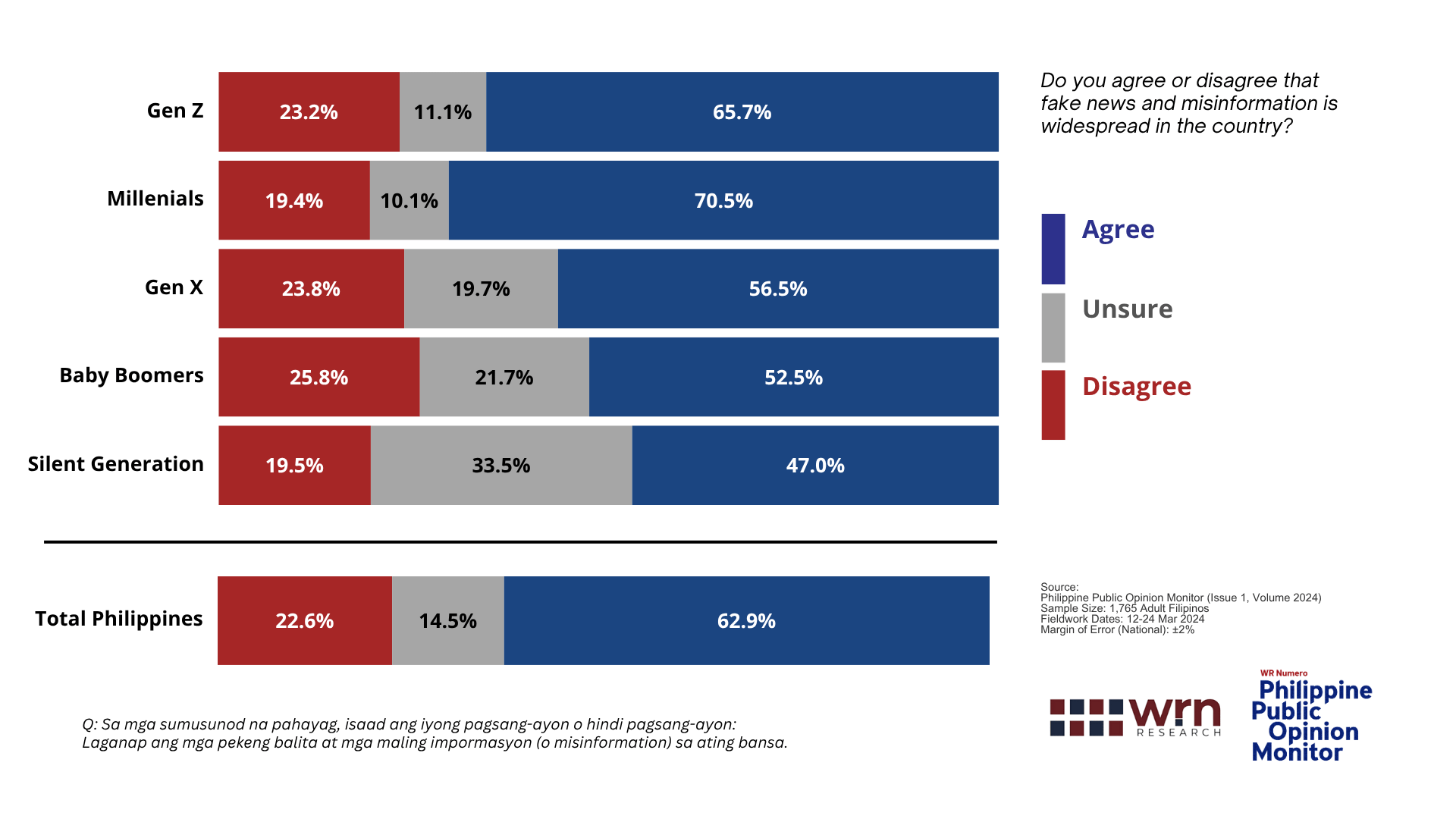
The generational pattern is telling. The generations most alarmed by misinformation are also the ones most embedded in digital platforms, where misinformation circulates most rapidly and abundantly. In this sense, awareness of misinformation functions less as evidence of a population getting smarter about the problem, and more as a measure of how thoroughly the problem has saturated daily life.
Recognition of misinformation does not stop at the platforms. It extends, significantly, to the journalists and media institutions that cover the news. Nationally, 55% of Filipinos believe that many journalists and reporters are biased and have vested interests.
Generationally, younger generations are most skeptical of the press. Nearly 63% of Millennials think that many journalists are biased in their interests, followed by Gen Zs at 57%. Older cohorts are less skeptical: Gen X at 49%, Baby Boomers at 47%, and Silent Gen at 35%.
Figure 2. Views on media bias
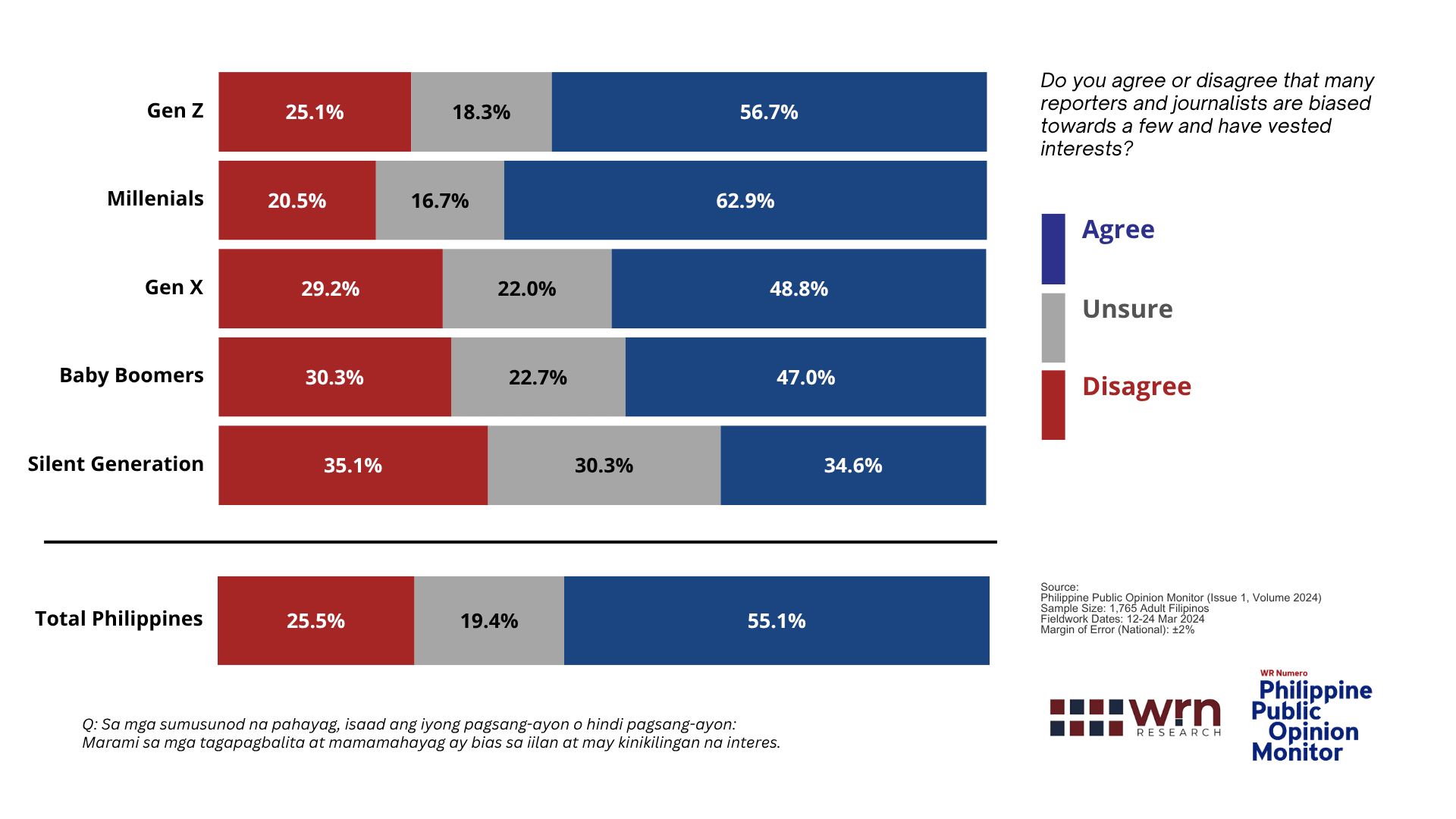
The generational spread here follows a recognizable pattern. Younger Filipinos, who consume more media across more platforms and encounter more competing narratives, tend to be more skeptical of the press. Older Filipinos, whose media habits were formed in an era when broadcasting meant a narrower and more regulated set of voices, extend somewhat more benefit of the doubt to journalists as a profession.
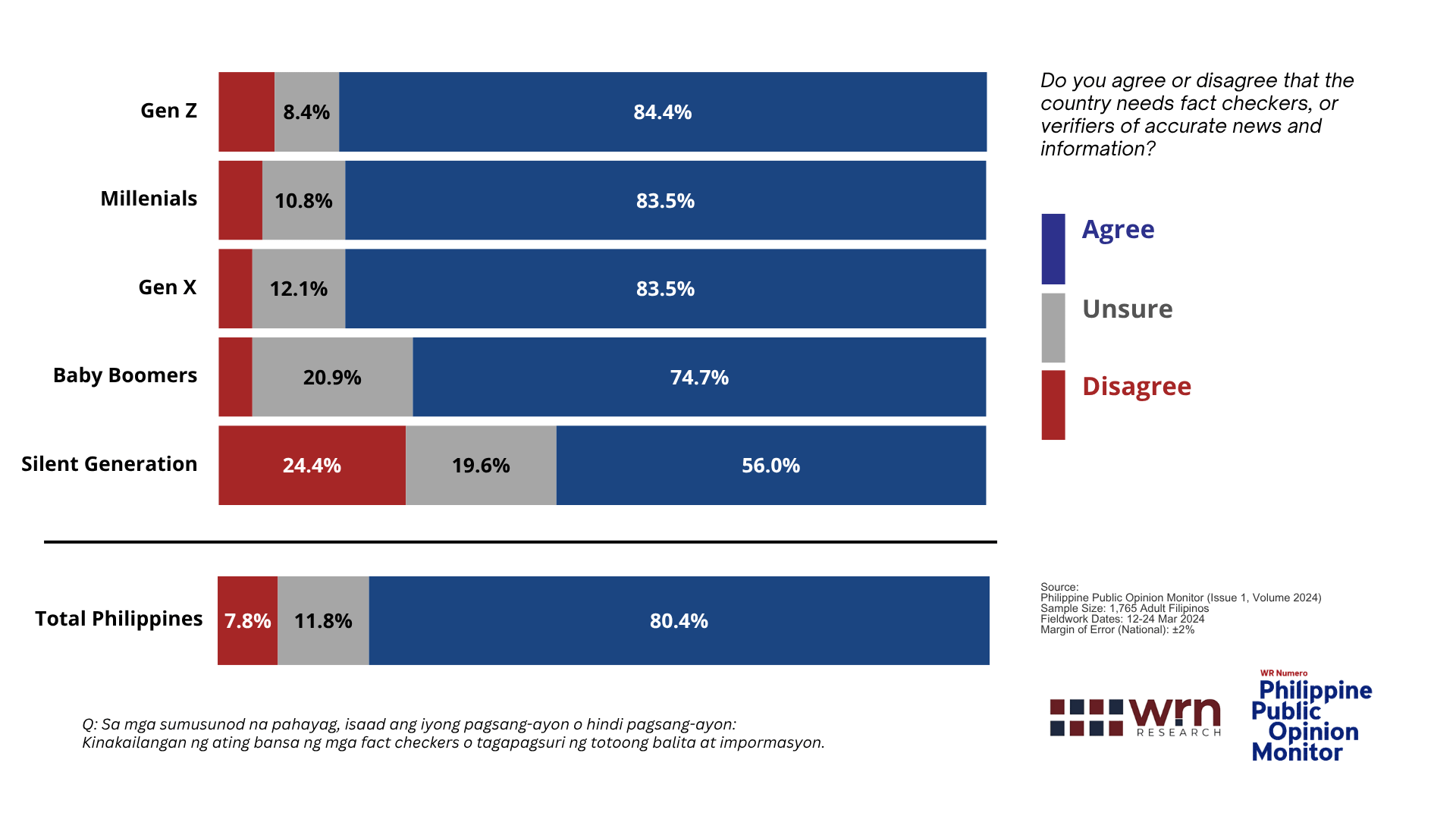
What makes these findings more than just data points is what sits alongside it. When asked whether the country needs fact-checkers to verify news and information, 4 in 5 Filipinos (80%) agree. That figure holds with remarkable consistency across generations.
Figure 3. Views on the need for fact-checkers
Organizations like Rappler’s #FactCheck, VERA Files, and Tsek.ph have been doing this work for years, and the Philippines has produced some of the region’s most respected verification journalists. But reach remains the binding constraint. As Vosoughi, Roy, and Aral (2018) demonstrated, false news spreads faster and farther than the truth across all categories of information. This is a structural disadvantage that fact-checking alone cannot overcome without broader platform-level cooperation.
Filipinos distrust Facebook, but they use it anyway
The trust-use gap becomes sharpest when the data on media trust and media consumption are placed side by side.
Television is the most trusted news source in the country by a wide margin, with half of Filipinos (50%) named it their most trusted platform. This is consistent with the Reuters Institute’s 2024 data showing that established broadcast brands like GMA Network command trust ratings as high as 72%. Television carries the credibility of regulation, professional production, and decades of familiarity. However, the same survey has also tracked the medium’s reach falling from 66 percent in 2020 to 46 percent in 2024, as younger generations increasingly look elsewhere.
Where they are looking is telling. Facebook is used daily by 62% of Filipinos, the highest frequent use rate of any platform in the March 2024 survey. It is, notably, also the most distrusted news source in the country, named by 39% of respondents as the platform they trust least, followed by TikTok at 24%. Online news websites, YouTube, and radio each occupy a middle ground: moderately used and trusted, without the sharp contradictions that define Facebook’s position in the data.
Figure 4. Most used, trusted, and distrusted sources of news and information
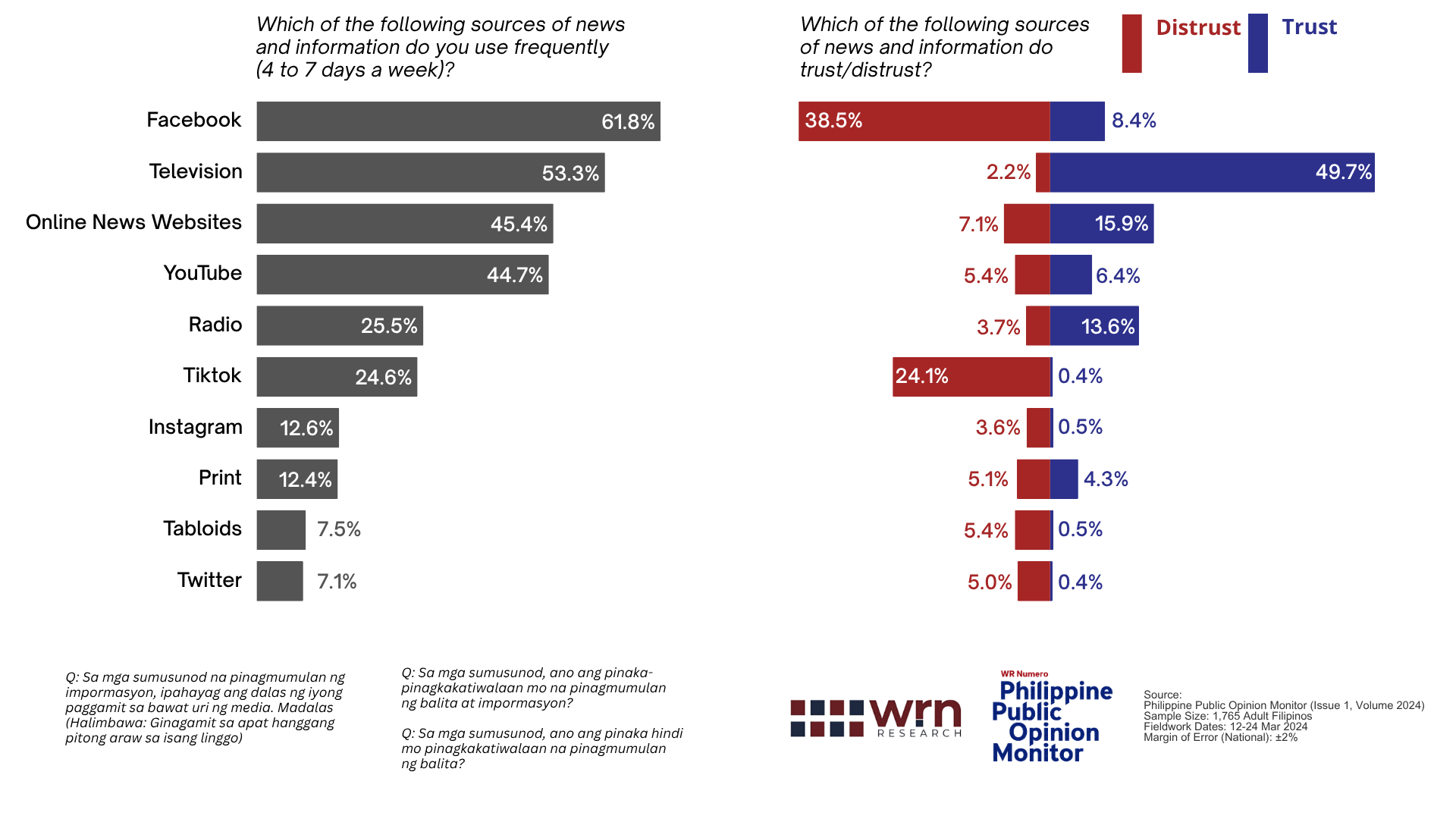
Filipinos are not consuming news on Facebook because they believe it is reliable, but because that is where the news is. Here, Facebook’s scale and social infrastructure make it, regardless of its trust deficit, the de facto public square of Philippine information life. Distrust of a platform and dependence on it are, the data shows, not mutually exclusive conditions.
Are influencers trusted sources of news?
The wariness Filipinos express toward mainstream media and social media platforms extends, with particular sharpness, to influencers, vloggers, and online personalities as sources of news.
Nationally, only about 33% of Filipinos agree that influencers deliver news fairly. The majority, at around 40%, disagree, with 28% unsure. The generational breakdown, however, reveals a pattern that cuts against easy assumptions.
Figure 5. Views on influencers and vloggers as sources of news
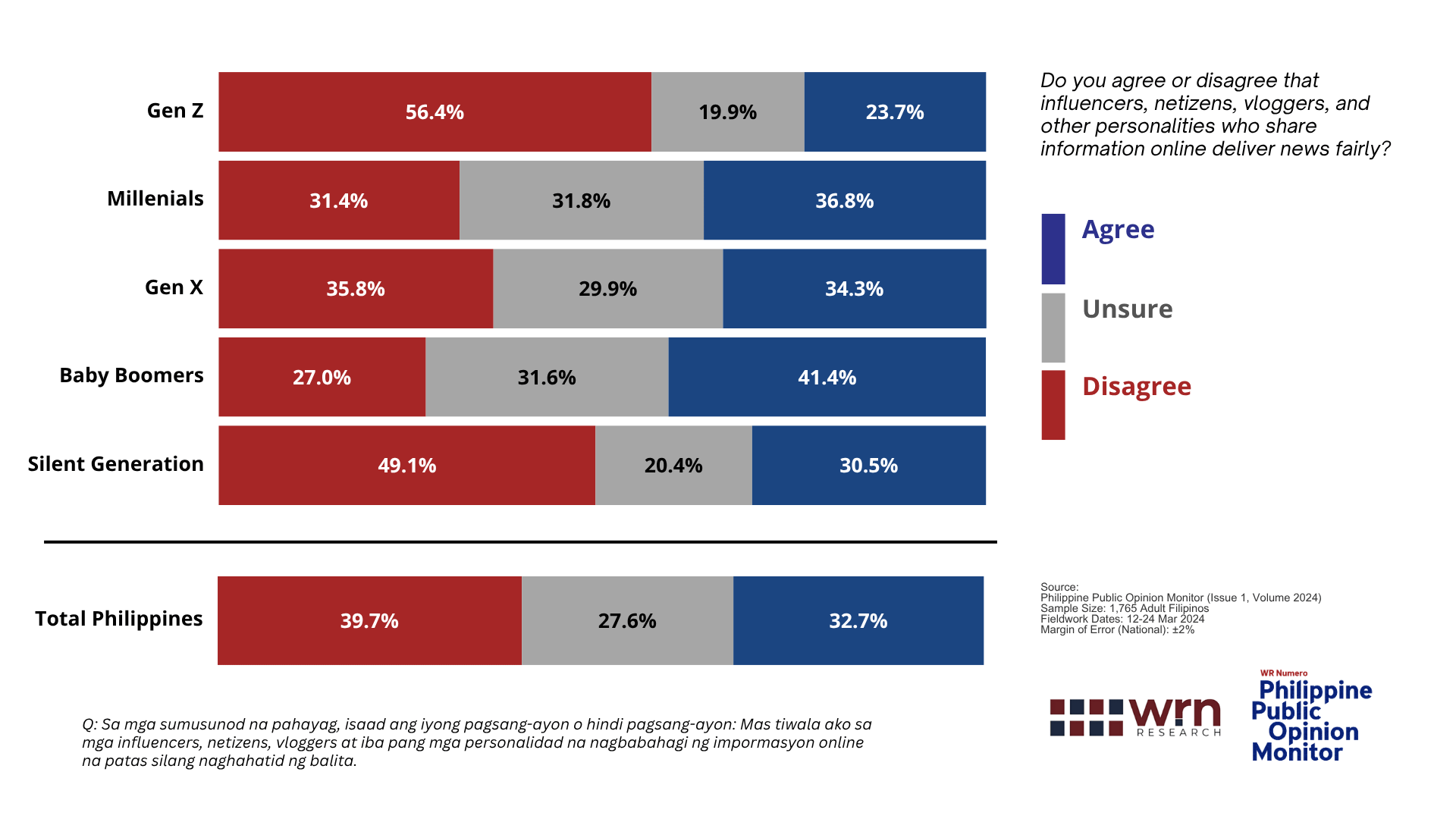
Gen Z is the most skeptical of influencers, with 56% of the cohort disagreeing that they are fair news sources. This is the generation most immersed in the platforms where influencer-driven content is the dominant format. Baby Boomers tell a different story. Around 41% of the cohort agree that influencers can be trusted to deliver news fairly. This is the highest of any generation, and well above the national average.
Baby Boomers’ relative openness to influencers as credible sources appears to reflect less a considered assessment of the format and more a transfer of the trust logic they developed in an era of broadcast media. As political operators in the Philippines have increasingly turned to influencer networks as tools of information influence, this generational trust profile warrants attention.
What now?
The survey data shows the quiet contradiction of everyday media life for millions of Filipinos. Filipinos are not, by and large, unaware that misinformation is a problem. While they distrust the platforms where misinformation lives, they still use them every day, because those platforms are where their families are, where political life happens, where the news—reliable or otherwise—is most accessible.
What this shows is that the challenge of misinformation in the Philippines is less about awareness. The problem runs deeper, built into the platforms people cannot afford to leave, and the habits that have quietly formed around them. Three implications follow from this.
First, the gap between awareness and behavior points to a structural problem rather than a knowledge problem. When a significant majority of Filipinos recognize that misinformation is widespread, and many identify Facebook as their most distrusted news source, and Facebook is largely used daily for news, the explanation is unlikely to be insufficient awareness. The more plausible explanation is that awareness, on its own, has no structural outlet. Media literacy interventions address the knowledge side of this equation, yet the infrastructure side remains largely unaddressed.
Second, as television’s reach continues to fall, the credibility it carries will not automatically migrate with audiences to digital platforms, and the gap that opens is one that less reliable sources are already filling. Television’s dominance in the trust rankings reflects decades of institutional investment and regulatory familiarity. The Reuters Institute data shows that established brands retain some online credibility, but the competition for attention in digital spaces is far more open, and far more susceptible to manipulation, than the broadcast environment that built those reputations in the first place.
Finally, the relatively higher trust that older Filipinos extend to influencers as news sources deserves more scrutiny than it currently receives. The standard anxiety about influencer-driven misinformation focuses on younger audiences, who are the heaviest consumers of influencer content. But the survey data suggests that Gen Z Filipinos are also the most skeptical of influencers as news sources. Baby Boomers, who use influencer platforms less but trust them more, may represent a more vulnerable audience profile for coordinated influence operations that use influencer formats as their primary vehicle. The risk, in other words, may not be where most of the attention is directed.
Although the survey data largely shows Filipino skepticism toward media and platforms, their overwhelming support for fact-checkers signals less an endorsement of fact-checking’s current state than a demand for a media system they can actually trust. While Philippine media has developed one of the region’s benchmarks for fact-checking, far less attention has been paid to what forms of fact-checking content actually work for the Filipino news consumer—one that accounts for their diverse media diets, trust orientations, and vernacular content.
But the burden of verification cannot rest solely on journalists alone, especially as platforms like Meta retreat from accountability, leaving fact-checkers to fight structural misinformation with limited reach and shrinking institutional support. Until platforms are held to a commensurate standard, even the best verification journalism will struggle to close the gap.
Filipinos are already aware that they are living inside an information disorder—a landscape so fragmented and polluted that the country earned the grim designation of ‘patient zero’ in the global fight against disinformation. Yet awareness alone has not been enough to escape it. The more pressing question, then, is not how to raise awareness further, but how to build a media environment where that awareness can finally translate into something more than frustration.
Note: The age of the respondents were self-reported across all surveys, which we then categorized into generations: the Silent Generation, born between 1928 and 1945; Baby Boomers, born between 1946 and 1964; Generation X, born between 1965 and 1980; Millennials, born between 1981 and 1996; and Generation Z, born between 1997 and 2012.
Acknowledgment
The author wishes to acknowledge the support and training provided by Internews, which were instrumental in the preparation of this article.
About the Author
Petronilo Figueroa III is a Senior Research Associate for Strategic Insights at WR Numero. He graduated BA Communication Research at the University of the Philippines Diliman.
Download
About WR Numero
WR Numero Research, Inc. is an independent and non-partisan public opinion research firm. Our mission at WR Numero is to build innovative computational, qualitative, and quantitative research methodologies to understand the attitudes and trends that shape Philippine politics and society. WR Numero is a subsidiary of the public affairs firm, WR Advisory Group.
About Public Opinion Letters
The WR Numero Public Opinion Letters is a regular series of research articles that provide in-depth analysis of data and trends on Philippine public opinion and the study of it.
About the Philippine Public Opinion Monitor
The WR Numero Philippine Public Opinion Monitor is the flagship research initiative of WR Numero that aims to measure and understand the socio-political opinions of Filipinos. Its unique contribution to the Philippine polling landscape is its specialized focus on tracking the political attitudes, behaviors, and preferences of Filipino adults from across the political spectrum, strategically segmenting partisan audiences and voter types, and analyzing the drivers of the dynamic shifts in their socio-political attitudes over time. You may access the previous issues of the Philippine Public Opinion Monitor here.
Methodology
The Philippine Public Opinion Monitor is a nationally representative survey, conducted face-to-face every quarter among 1,800 Filipino adults across the country. All aspects of the survey, from design and administration to processing and analysis, were carried out by WR Numero Research, Inc. The Philippines was divided into four study areas: National Capital Region, North and Central Luzon, South Luzon, Visayas, and Mindanao. By design, each of these sites were allocated sample sizes according to probability proportional to population size of the study areas. Multi-stage probability sampling was used in the selection of the sample spots (barangays).
You may view the complete methodological note of the survey cited in the article here: